

.svg.png)

How to Create an AI Agent
Rapid developments in the field of artificial intelligence have brought about profound transformations in many areas of the business world. One of the most remarkable actors in this transformation are representatives of artificial intelligence, known as AI Agents.
So what is AI Agent, how is it developed and why does it play such a critical role for businesses? In this article, we will cover in detail the development process and areas of use, starting with the basics of AI Agents.
How to Develop an AI Agent in 7 Steps
The AI Agent development process brings together many technical disciplines. Properly planning and structuring this process is the foundation for building a successful AI Agent. Here are the seven basic steps that make up this process:

1. Identification of the Problem
The first step to developing a successful AI Agent is a clear definition of the business problem to be solved. What tasks will the agent perform? Who is the user? What is the targeted output? For example, if you are developing a customer support agent, it should be defined in advance which channels the user will come from, what types of questions they will ask, and what kind of responses they will expect. As the problem becomes clear, the easier the technical requirements are formed.
2. Data Collection and Preparation
AI agents need data to learn and make the right decisions. In this step, both structured (form data, historical records) and unstructured (chat history, documents) data must be collected. This data should be cleaned, tagged and anonymized if necessary. The labeling process is critical, especially for systems using supervised learning.

3. Model Selection and Training
The appropriate AI model is selected according to the needs of the Agent. For example, major language models (LLMs) are preferred for an agent who needs to understand conversations, while CNN-based image recognition models may be required for an agent to perform visual analysis. During model training, the collected data is fed to the model and the learning process is initiated. At this stage, the model needs to be optimized for problems such as overfitting and underfitting.
4. Creation of Rules and Logic Layers
Artificial intelligence may not always be enough; certain rules, checkpoints, and manual definitions must also be integrated into the system. For example, an agent focused on customer satisfaction should be sensitive to certain words and be able to direct when he hears certain phrases. In this layer, configurations such as conditional responses, fallback states, user authorizations come into play.

5. Integration Phase
Not only the “mind” of the AI Agent, but also the “working environment” must be well structured. It is determined on which channels the Agent will be located (website, WhatsApp, mobile application, call center, etc.). Connections to these platforms are provided through methods such as REST API, webhook or SDK. In addition, synchronization with the company's CRM, ERP or databases must be provided.
6. Test and Validation
The developed agent is extensively tested over user scenarios. Edge-case scenarios, user errors, and unexpected questions must be considered. Agent responses are evaluated, bugs are corrected, user experience issues are fixed, if any. A/B tests and user tests can be applied in this process.

7. Publishing and Continuous Monitoring
After the AI Agent is brought into the live environment, the actual process begins. The agent, which interacts with users in real time, is constantly monitored and improved based on feedback. Based on the collected data, performance measurements are made, improvement points are identified and new versions are published. The model can be retrained or the answer sets can be updated.
What is an AI Agent?
AI Agents (Artificial Intelligence Agents) are software-based agents who can make decisions based on this data by collecting data from their environment, automatically performing specific tasks in line with their decisions. In a sense, they behave like an entity capable of thinking, perceiving and acting in the digital environment. These agents take on repetitive tasks that take up people's time, speeding up, optimizing business processes and enabling human resources to be directed to more strategic areas.
AI Agents are not limited to chatbots. A product recommendation engine on an e-commerce site, a digital consultant in a banking application, or a quality control system on a production line can all be examples of AI Agents. Each takes on a different task, but what they have in common is that they interact with their environment, interpret the information they have learned and take action.
You can review the main features and uses of AI Agents here.

What is the technical structure of AI agents?
Behind an AI Agent is a multi-layered technical architecture that makes it “smart”. This architecture both guides decision-making processes and allows it to interact with the outside world. Core components include sensor modules, decision engines, action units, and learning mechanisms.
Sensing modules receive input from users, such as text, sound, or images. This data is processed by techniques such as natural language processing (NLP), image recognition or sound analysis. Then the decision engine kicks in. Here, rules-based systems or artificial neural networks determine an appropriate action by analyzing the data received. The action unit, on the other hand, responds to the user in accordance with the decision, triggers an API, or initiates an operation in a system. Thanks to learning mechanisms, these processes become more accurate over time; the agent improves himself as he gains experience.

In which business areas are AI agents used?
AI representatives have become a cornerstone of many industries, not just technology companies, but also retail, healthcare, finance, manufacturing and education. In retail, AI Agents can increase sales by offering personalized product recommendations, while in the healthcare field they can perform tasks such as patient appointment scheduling, medication tracking, and symptom analysis.
In the financial sector, many tasks such as customer service, automated credit pre-assessments, fraud detection can be performed with AI Agents. In the educational world, on the other hand, virtual teachers who offer content and provide feedback according to the individual levels of students are becoming widespread. Regardless of the industry, the main goal of AI Agents is to improve efficiency and user experience by automating decision-making and operations processes.

Why should you work with an AI agent?
- 24/7 Active Service: Provides service around the clock, without depending on manpower.
- Cost Saving: Reduces operational costs by taking over repetitive operations.
- Fast Response and High Satisfaction: Eliminates waiting time by responding to users instantly.
- Consistent and Error-Free Operation: Provides service to every user of the same standard, minimizes human error.
- Scalability: Although the volume of work increases, it offers scalable structure without sacrificing quality.
- Data-Driven Decision Making: Strategic analyses can be performed on user data interacting with the Agent.
Platforms You Can Use to Develop AI Agents: Grispi and Vivollo
Choosing the right platform in the AI Agent development process is the key to success. Here are two platforms that stand out in this area:
Grispi: AI-Powered Platform That Empowers Customer Experience
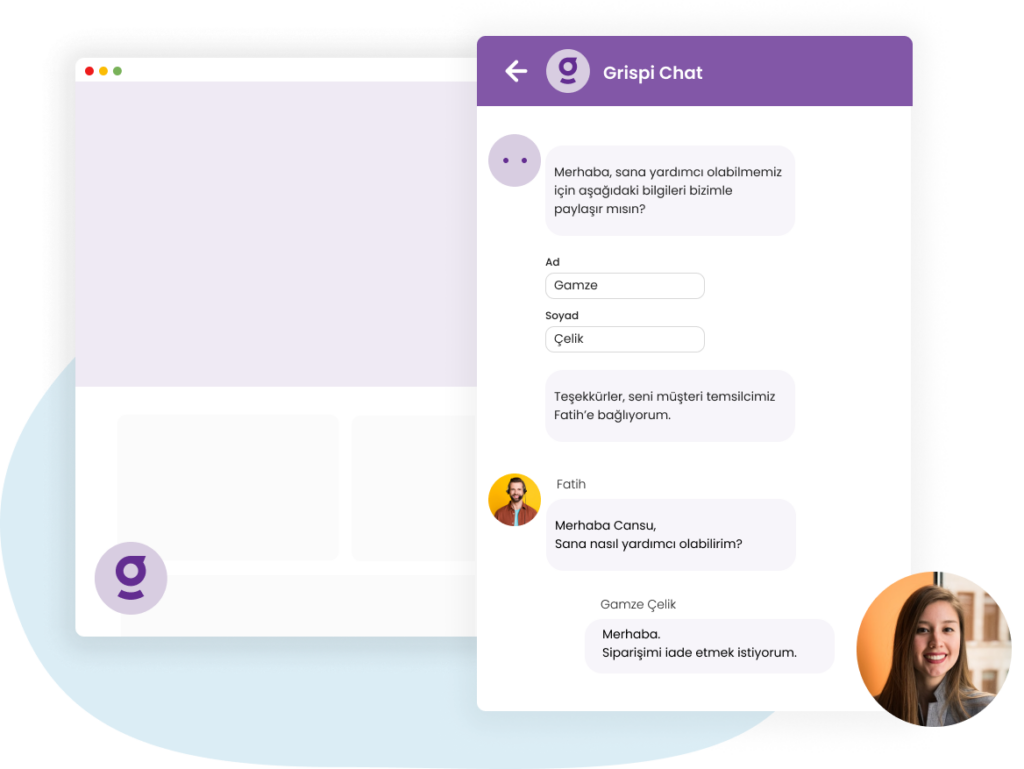
Grispi is a comprehensive customer experience platform that helps businesses improve the customer experience. Thanks to its AI-powered solutions, it automates customer service processes, increasing efficiency and increasing customer satisfaction.
Features Grispi offers include customizable chatbots, live chat widgets, and interactive experiences. These tools can be used to answer customer questions, provide support, and increase sales.
Vivollo: Comprehensive AI Agent Development Platform

Vivollo is an all-in-one platform that enables businesses to create and deploy AI-powered customer support representatives. The platform is equipped with features such as a visual stream builder, ready-made templates, and multi-channel support.
The AI-powered browsing feature offered by Vivolo allows you to develop a custom AI model for your business by scanning your website or other resources. Also, thanks to Vivolo's integration with Grispi, the AI representative can seamlessly transfer the conversation to a real agent when the AI representative is unable to resolve a customer request.
Developing AI Agents is an Investment in the Future
AI Agents make it possible for businesses to both gain an advantage in today's competitive conditions and increase their digital competencies in the future. A properly configured AI Agent is not only a software; it is also an operations partner, a customer representative, and a decision support system. If you also want to transform your business processes, reduce costs and improve the user experience, now is the time to step into the AI Agent development process.
Contact us
Fill in the form for detailed information and demo account, we will call you.
Müşteri deneyimi için çözümler
Çok kanallı destek, satış otomasyonu ve yapay zeka gücünü tek bir platformda birleştirin. Operasyonel verimliliği artırarak müşteri sadakatini güçlendirin ve ölçülebilir sonuçları hemen görmeye başlayın!
