
.svg.png)

What is Outsourcing?
![20945858 [Dönüştürülmüş]](https://cdn.prod.website-files.com/691863e040d6bcd46f0e4eb2/697b4e30e74a54d3410afece_20945858-Donusturulmus.svg)
The growth of companies and the achievement of a more efficient working order is very important in today's competitive business world. In order to manage business processes effectively, companies can obtain time and cost advantages by outsourcing certain services or operations. This strategy is called “outsourcing” or “outsourcing” in English.
So, what exactly is outsourcing, why is it preferred and what advantages does it give firms? In this article we will look for answers to these questions.

What is Outsourcing?
Outsourcing means that a company outsources certain business processes or services to an outside firm instead of executing them in-house. This method refers to outsourcing jobs that specifically require expertise, require technical knowledge and experience, or can be costly. Companies often prefer outsourcing for operations such as IT services, human resources, customer service, accounting, marketing, and call center.
Outsourcing can be quite advantageous not only for large companies, but also for small and medium-sized enterprises (SMEs). SMEs can both accelerate their work and direct their resources to more strategic areas by outsourcing certain business processes.

Advantages of Outsourcing
Outsourcing is a strategy that allows businesses to make their operations more efficient. With this method, firms provide many advantages by transferring certain services or business processes to specialized external companies instead of carrying out their own business processes.
Now let's examine in more detail the advantages of outsourcing.
To have knowledge of the strategies necessary to retain customers You can take a look at this article.
1. Cost Saving
One of the biggest advantages of outsourcing is the reduction of costs. There are many cost items for the operations that a business performs within itself, such as personnel, infrastructure, technology and training. But thanks to outsourcing, these costs can be reduced to a minimum. Instead of technological infrastructure or personnel employment, which requires large investments, especially for small and medium-sized enterprises, outsourcing certain processes allows obtaining high-quality services at a lower cost.
Outsourcing also offers businesses a variable cost advantage rather than fixed costs. For example, in seasonal job volume increases, enterprises can manage these processes with external resources and use temporary labor flexibly, thus relieving themselves of the costs associated with constant staffing.
2. Leveraging Expertise and Experience
Many business processes require a certain expertise and experience. It is difficult and costly to build an expert staff, especially in areas such as IT services, law, human resources, digital marketing. Thanks to outsourcing, enterprises can delegate work requiring such expertise to professionals and receive high-quality services.
Outsourcing firms are usually made up of teams that specialize in their field and know best practices in this regard. These teams contribute to your business by providing fast and accurate solutions. Businesses work with expert teams that follow technological developments and industry trends through outsourcing to both improve their business and minimize the risk of erroneous transactions.
If you are wondering what customer onboarding is this article is just for you.
3. Focus and Productivity Increase
Outsourcing offers companies the opportunity to focus on their main areas of activity. Particularly time-consuming, repetitive or operational business processes can hamper a firm's growth strategies and innovative solutions. When this type of work is outsourced, resources within the enterprise can be diverted to more strategic and creative work.
For example, a technology firm can outsource customer service or accounting operations to devote more time to its core business, such as software development and innovation. This increases the competitiveness of the company and allows it to advance faster in the market.

4. Saving Time and Speed
Outsourcing brings speed to businesses. Because outsourcing firms are often specialized in a certain process, they can get things done faster and error-free. Thanks to this, the operational processes of companies are accelerated and they can adapt faster to market conditions.
In addition, some business processes may require continuous operation. For example, operations such as customer service or IT support may have to provide 24/7 service. It is difficult to manage such continuous business processes, and it can be costly for the enterprise to organize all these processes in-house. But with outsourcing, enterprises delegate such processes to a professional team, ensuring that things continue without interruption.
5. Risk Management
Every activity in the business world carries certain risks. External factors such as technological developments, legal regulations or economic fluctuations can pose risks to businesses. Outsourcing minimizes these risks, as it enables certain business processes to be managed by specialized firms.
The experience and know-how of outsourcing companies, especially in critical areas such as IT security, data management, compliance requirements, reduces risks. These companies contribute to minimizing legal and operational risks by managing processes in accordance with the standards.

6. More Efficient Use of Resources
Outsourcing gives businesses the opportunity to use their resources more effectively. When the operational loads on which internal resources work are transferred to the outside, the employees and equipment of the enterprise can be used for more strategic work. For example, the software team within the company can focus on new projects instead of daily maintenance and support work.
In addition, businesses that gain flexibility through outsourcing can respond faster to market conditions and customer demands. They can easily adapt to the changing volume of work by increasing or decreasing resources when necessary.
7. Access to Technology
Some business processes require advanced technology, and investing in these technologies can be a huge financial burden. Because outsourcing firms have these technologies, they allow businesses to run their business processes using the latest tools and software. Taking advantage of technological innovations, especially in areas such as IT services and digital marketing, becomes easier with outsourcing.

Take Advantage in Outsourcing with Grispi
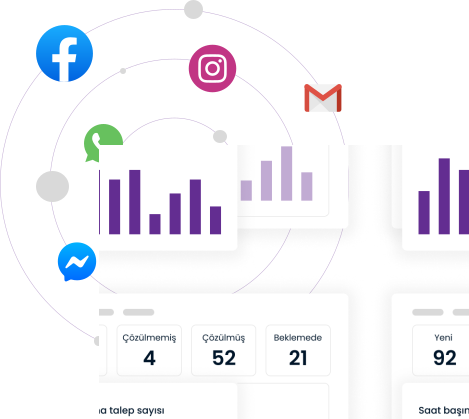
Efficiency and monitoring of business processes are of great importance in outsourcing. At this point, Grispi enables firms to stand out by integrating customer relationship management and business processes into outsourcing.
Grispi optimizes customer support, sales, call center and marketing processes to avoid potential disruptions in outsourcing. With Grispi, companies can easily manage their business processes both in-house and with outsourcing companies. This allows you to maintain control in outsourcing, track processes more effectively, and increase customer satisfaction.
Outsourcing is an effective method for companies to optimize their business processes and reduce costs. When the right business processes are managed with the right external resources, companies can both lighten their workloads and achieve faster and more efficient results.
Managing outsourcing by using customer support software such as Grispi provides additional benefits to firms, making business processes more organized and controlled. You can take your company one step ahead by taking advantage of the opportunities provided by outsourcing.
Contact Us
Fill in the form for detailed information and demo account and we will call you.
Müşteri deneyimi için çözümler
Çok kanallı destek, satış otomasyonu ve yapay zeka gücünü tek bir platformda birleştirin. Operasyonel verimliliği artırarak müşteri sadakatini güçlendirin ve ölçülebilir sonuçları hemen görmeye başlayın!
